Karteradhos
In the beating heart of Santorini, just a short distance from the cosmopolitan bustle of Fira, stands Karteradhos, a village that...
Updated 7 July 2026
The story
The story of Karteradhos
Roots in the name: between ambushes and seafaring
The name Karteradhos has its roots in the Greek word 'karteri', which literally means 'observation point' or 'ambush'. In the past, the village's strategic position, located in a natural sheltered basin but close to the coast, made it the ideal place to spot pirate ships that infested the Aegean. Inhabitants could thus prepare for defence or hide in dwellings carved into the rock. However, the village's true golden period coincided with the nineteenth century, when Karteradhos became one of Santorini's most prosperous centres thanks to its merchant fleet. Sea captains, enriched by trade between the Black Sea and the Mediterranean, chose this place to build their sumptuous mansions, bringing a touch of neoclassical elegance that can still be admired among the narrow streets of the historic centre.
Hypogeal architecture and historic dwellings
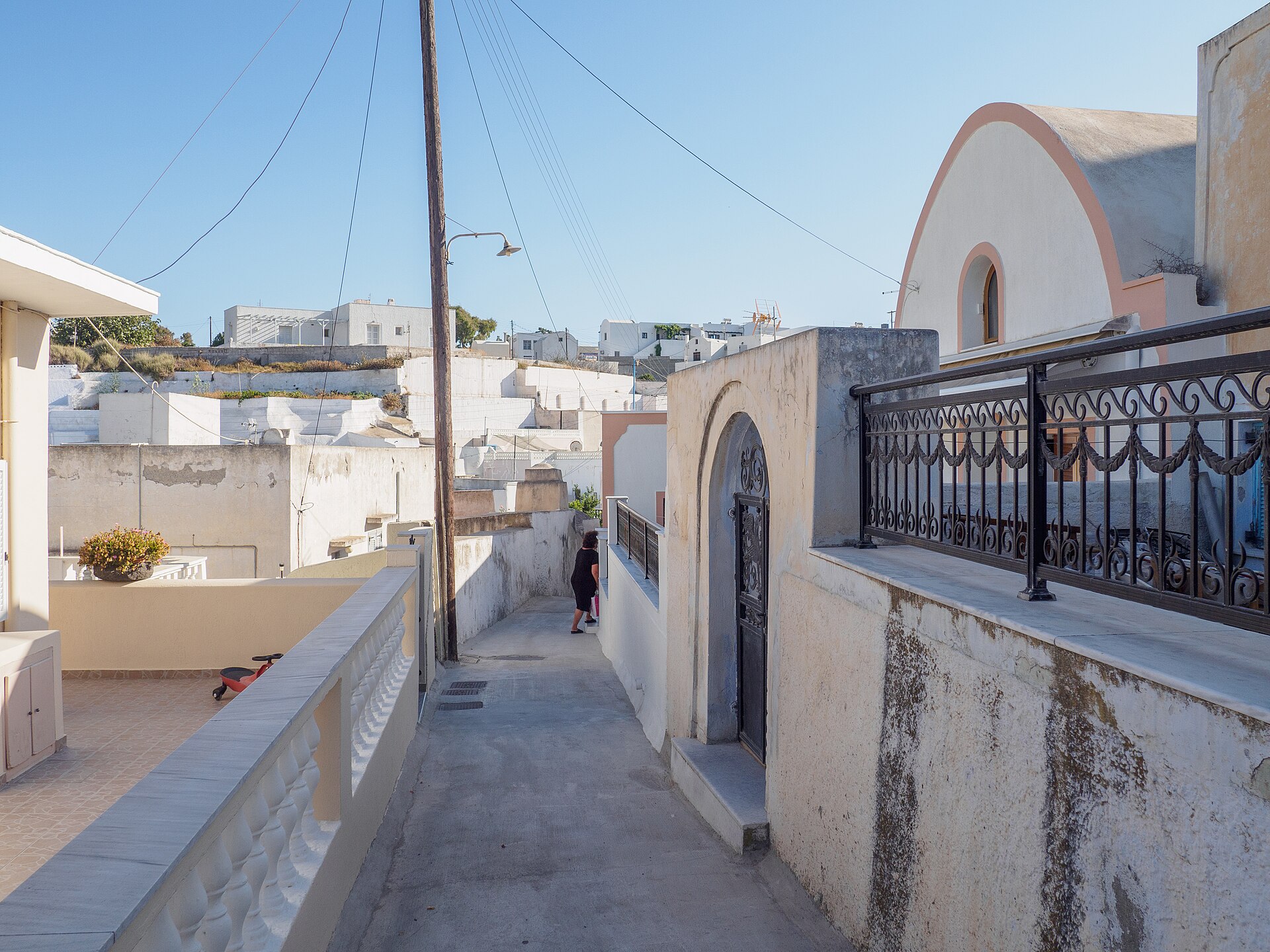
What makes Karteradhos unique in the Santorini landscape is the coexistence of two opposite architectural styles. On one hand there are the 'hyposkafa', cave-houses carved into the flanks of pumice ravines. These dwellings, originally destined for the lower classes, are today considered masterpieces of bioclimatic architecture, capable of maintaining a constant temperature throughout the year. On the other hand, the village is dotted with imposing 'archontika', the manor houses of nineteenth-century sea captains. These structures are distinguished by coloured facades, carved stone portals and spacious internal courtyards, reflecting the Venetian and neoclassical aesthetic that influenced the island during centuries of dominion and commercial exchanges.
The Church of the Ascension (Analipsi)
Located in the heart of the village, the Church of the Ascension of Christ (Analipsi) is the main religious and architectural landmark of Karteradhos. Built in the nineteenth century, it perfectly embodies the Cycladic style with its imposing blue dome and bell tower rising against the clear sky. The interior is a profusion of Orthodox spirituality, with finely crafted iconostasis and frescoes that tell biblical stories in vibrant colours. The church is not merely a place of worship, but the centre of social life: its forecourt hosts the village's main festivities, moments when the community gathers to celebrate ancient traditions amidst music and folk dances.
Agios Nikolaos: a jewel among the rocks
Dedicated to the protector of sailors, the church of Agios Nikolaos is a small masterpiece of popular devotion. Its position, slightly set back from the main street, bestows an atmosphere of absolute peace. Characterised by an immaculate white structure and soft, almost organic forms, the church seems to emerge directly from the volcanic earth. It is particularly striking at sunset, when the warm light of the sun ignites the contrast between the white of the lime and the blue of the doors. Entering this sacred space means breathing in the maritime history of Karteradhos, made of prayers for navigators and gratitude for safe returns after months at sea.
Eisodia tis Theotokou: faith suspended in time
Another sacred building of great significance is the church of Eisodia tis Theotokou (Presentation of the Virgin at the Temple). Located in an elevated area, it offers a panoramic view spanning the surrounding vineyards to the sea. This church stands out for its refined architectural details and the care with which it is maintained by the local community. Its annual celebration is one of the village's most cherished events, an occasion when the village dresses up and visitors can witness century-old rites that blend religious faith with Greek cultural identity. The simplicity of its external lines conceals an interior rich in ex-votos, tangible testimony to the deep devotion of the inhabitants.
Windmills and the rural heritage
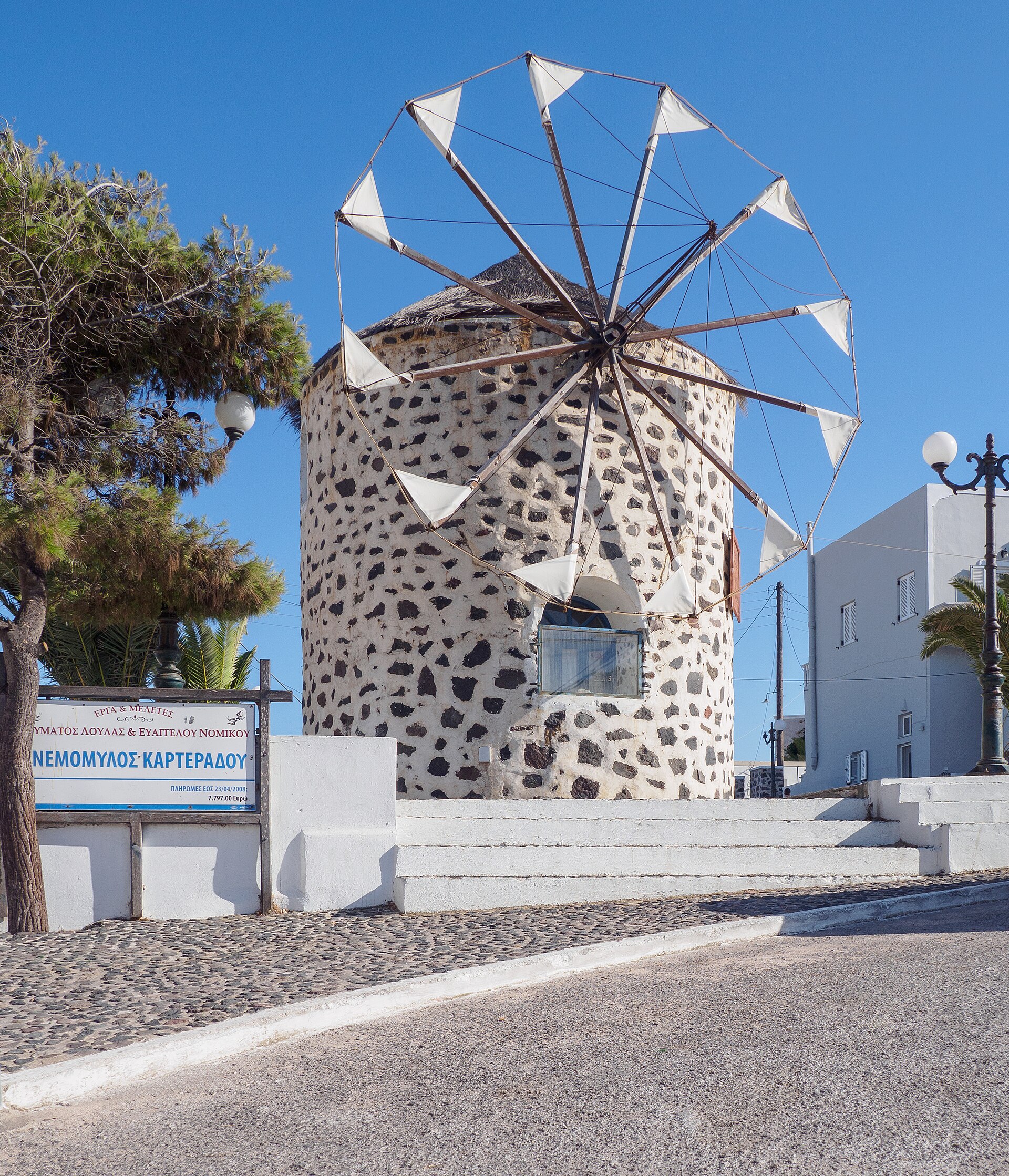
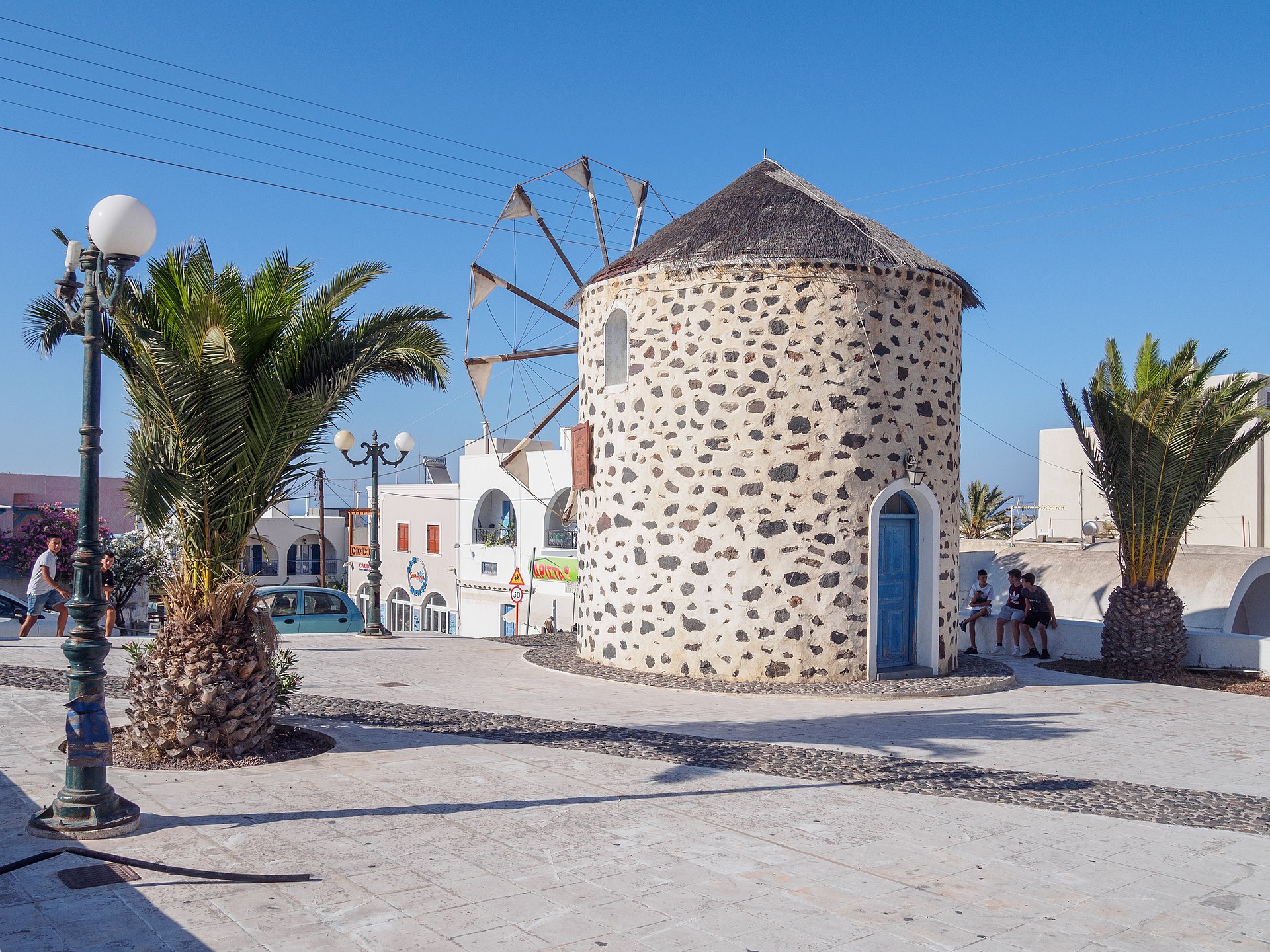
At the entrance to the village, you can glimpse the remains of ancient windmills, once fundamental to the island's agricultural economy. Although many are no longer in operation today, they remain silent sentinels of Karteradhos's rural past. These stone giants were used to grind grain by harnessing the strong winds that blow across the Cyclades. Their presence reminds us that, before the advent of tourism, life in Santorini was marked by the cycles of earth and sea. Walking near these structures offers a suggestive glimpse and allows understanding of territorial organisation in the pre-industrial era.
Exo Gialos: the breath of volcanic sea
Descending towards the eastern coast, a few kilometres from the inhabited centre, you reach Exo Gialos, the reference beach for Karteradhos residents. It is a wild and fascinating stretch of coast, characterised by dark sand and volcanic pebbles, framed by tall tufa cliffs sculpted by erosion into bizarre forms. Here the sea is deep and crystalline, ideal for those seeking a bathing experience far from the crowds of more famous beaches. The adjacent small fishing port adds a picturesque touch, with colourful boats bobbing on the water and a few taverns where you can taste the freshest fish just landed.
Vineyards and flavours: local gastronomy
The landscape surrounding Karteradhos is dominated by vineyards, where Assyrtiko vines are cultivated using the 'kouloura' method, in a low basket shape to protect the bunches from wind and drought. This ancient technique allows the production of white wines of extraordinary minerality. Beyond wine, Karteradhos's table offers the genuine flavours of volcanic earth: the famous Santorini fava (a lentil puree), tomatokeftedes (fritters of small, tasty local tomatoes) and wild capers. Eating in one of the village's traditional taverns means taking a sensory journey through Aegean gastronomic culture, made of simple ingredients but full of character.
- Get lost among the alleys of the ancient quarter to admire the houses carved into the rock.
- Visit the Church of the Ascension to observe its architecture and interior details.
- Take a sunset walk towards the windmills at the entrance to the village.
- Reach Exo Gialos beach for a swim in the deep and volcanic waters.
- Taste the local wine in one of the traditional wineries in the area.
- Walk the path connecting Karteradhos to Fira in about 20 minutes.
When to go and how to experience the village
Karteradhos is an enjoyable destination throughout the year, but spring (April-June) and early autumn (September-October) represent magical moments. In these periods the temperatures are mild, the paths are in bloom and the island breathes an air of regenerating tranquillity. During summer, the village offers a cool and quiet refuge from the chaos of the capital, while still allowing easy access to every attraction. To fully experience the place, the advice is to explore it on foot in the early morning hours, when the raking light enhances the profiles of the houses and the village wakes up slowly to the sound of bells and the daily gestures of its inhabitants.
FAQ
Quanto dista Karteradhos da Fira?
È facile parcheggiare a Karteradhos?
La spiaggia di Exo Gialos è attrezzata?
Karteradhos è adatta alle famiglie?
Getting there
- Aeroporto Internazionale di Santorini (JTR) - 4 km
- Non presenti sull'isola
- Da Fira seguire la strada principale verso sud; Karteradhos è il primo villaggio che si incontra. Ben collegato dalla rete di bus locali (KTEL).
- Se arrivate in traghetto al porto di Athinios, prendete il bus per Fira e scendete alla fermata di Karteradhos, situata lungo la via principale.
Perfect for
Perfetto per chi vuole scoprire la Santorini meno turistica, fatta di case-grotta e vita di quartiere autentica.
Un mix affascinante tra le umili abitazioni ipogee e le eleganti ville neoclassiche dei capitani ottocenteschi.
Base ideale per esplorare l'isola, vicinissimo a Fira ma con costi più contenuti e molta più quiete.
To see