Foinikia
While the whole world gazes toward the fiery sunsets of Oia's caldera, just a few steps away lies a place where time seems to have...
Updated 7 July 2026
This season · July · Summer
What to do in Foinikia now
The story
The story of Foinikia
The roots of Foinikia: between myth and agriculture
The history of Foinikia is intrinsically linked to the fertility of Santorini's volcanic soil. Its name appears to derive from the Phoenicians, who according to some theories would have frequented the island in remote times, or more likely from the presence of a lush palm tree (phoenix in Greek) that rose in the center of the village. Unlike centers overlooking the caldera, often born for defensive or maritime commercial purposes, Foinikia developed as a purely agricultural settlement. During the period of Venetian rule and subsequently under the Ottoman Empire, the village became the pulsing heart of wine production in the Oia area. Here lived the farmers who worked the surrounding vineyards, building their homes above or next to the cellars where the precious Assyrtiko wine was left to age.
The architecture of the Canaves: houses sculpted in time
What makes Foinikia architecturally extraordinary is its urban structure based on the 'canaves'. These structures, originally conceived as cellars for winemaking, were carved directly into volcanic tuff. Their vaulted shape guaranteed a constant temperature, ideal for wine preservation. Over time, many of these caves were transformed into welcoming homes, while maintaining their characteristic narrow openings and curved ceilings. The external facades of Foinikia are distinguished by the use of natural pigments ranging from saffron yellow to terracotta red, a chromatic choice that protected the eyes from the sun's glare and today gives the village a warm and welcoming aesthetic, profoundly different from the monochromatic minimalism of other Cycladic villages.
The Church of Panagia Matrona: the spiritual heart
The most iconic monument in the village is undoubtedly the church of Panagia Matrona, built in 1859. Located in a position that dominates the settlement, it is immediately recognized by its slender bell tower and the large palm tree that rises in the courtyard in front, a living symbol of the village's name. The church is dedicated to Saint Matrona of Chios and represents the focal point of community life. On October 20th each year, the village awakens for the patronal festival, one of the most deeply felt celebrations on the entire island. During this occasion, the streets fill with traditional music, dancing, and the aroma of typical dishes offered to pilgrims. The interior of the church, with its finely carved iconostasis, is a splendid example of local devotion and Byzantine art.
Agia Kyriaki and the viewpoint over the sea
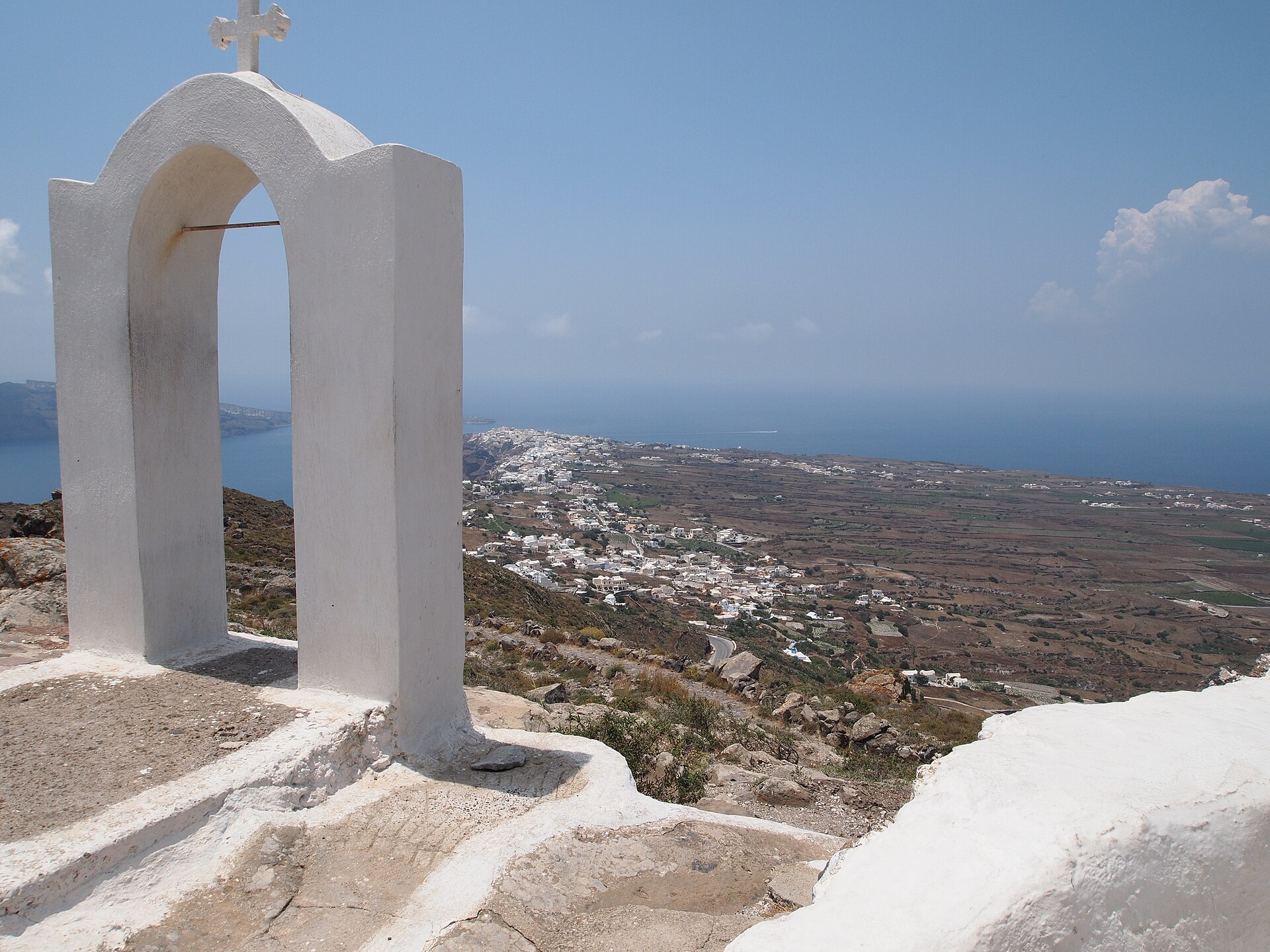
A short distance from the town center, following a path that winds through the vineyards, lies the small chapel of Agia Kyriaki. This white chapel, with its blue dome reflecting the color of the sky, offers one of the most enchanting panoramic points in the area. From here, the gaze sweeps freely toward the northern coast of Santorini, embracing the cultivated plains that slope gently toward the beaches of Baxedes and Paradise. On clear days, the horizon is populated with the silhouettes of nearby islands, such as Ios, Sikinos, and Folegandros. It is the perfect place to enjoy the 'golden hour', when sunset light tints the rocks and sea pink, in a regenerating solitude that contrasts with the crowds pressed against the fortifications of Oia.
The vineyards of Foinikia: the art of Kouloura
The landscape surrounding Foinikia is a mosaic of low vineyards, cultivated with the ancient method of 'kouloura'. To protect the bunches from fierce winds and drought, vintners weave the vine branches into a basket shape, allowing the grapes to grow protected in the center, close to the soil rich in minerals. This millennia-old cultivation method is a form of environmental art that defines the identity of the territory. Walking through the rows, one perceives the toil and wisdom of a land that, despite its aridity, produces white wines of extraordinary acidity and salinity. Many of the village's ancient canaves have been recovered today and transformed into boutique wineries where it is possible to taste the local nectar accompanied by locally sourced products.
Baxedes and the northern coast
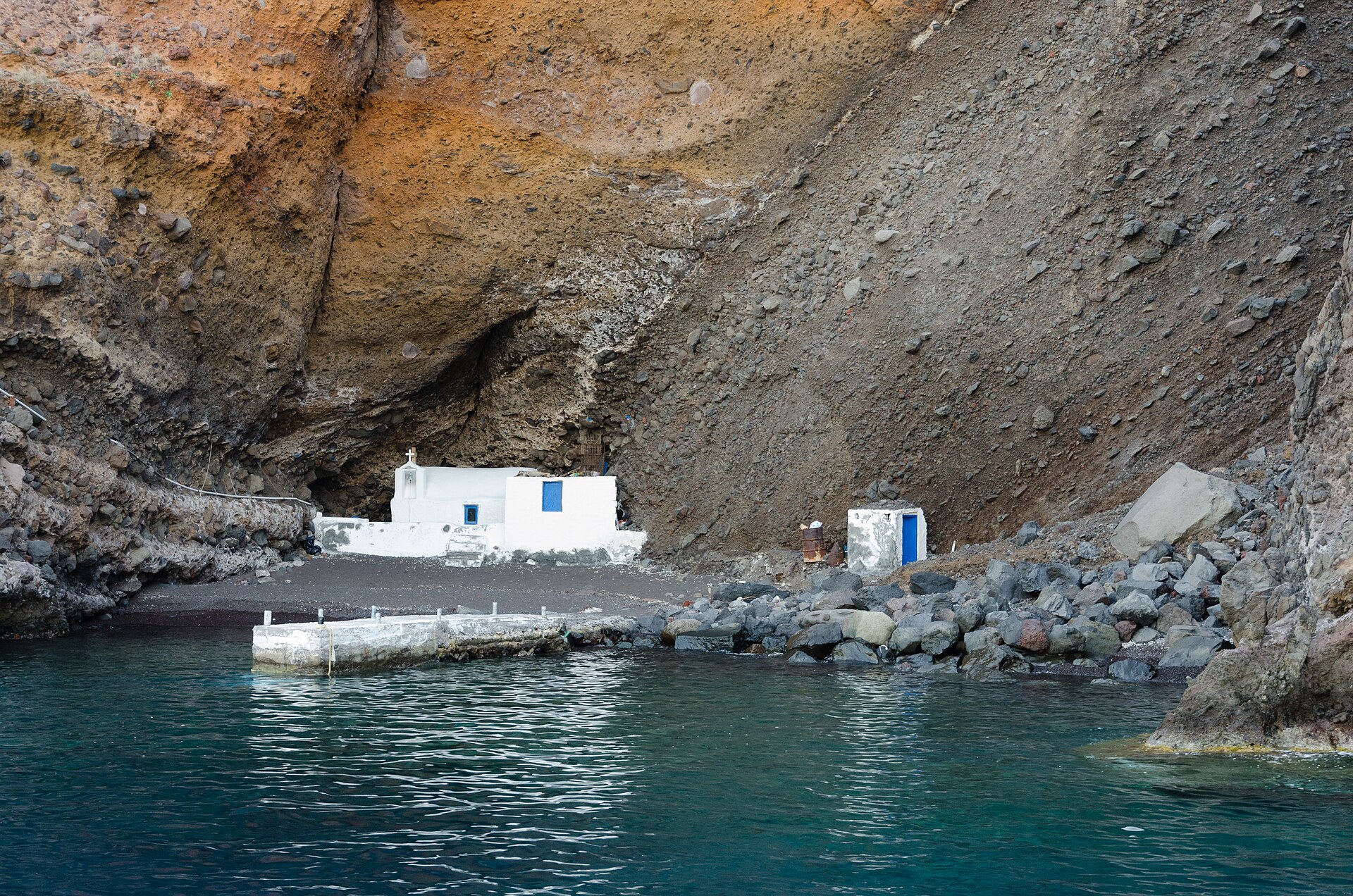
A short distance from Foinikia lies Baxedes beach, the bathing destination of reference for those staying in the village. This long expanse of dark sand and volcanic pebbles represents the wild side of Santorini. Exposed to northern winds, Baxedes is characterized by crystal-clear waters and deep seabeds, ideal for those who love the sea in its most natural and least domesticated form. Along the coast, one can admire rock formations sculpted by erosion that seem like abstract sculptures. Despite proximity to tourist centers, this area retains a rustic character, with a few traditional taverns serving fresh fish and vegetables grown in the gardens behind, irrigated with ancient wisdom that defies the island's lack of water.
Gastronomic traditions: the flavors of the volcano
The cuisine of Foinikia reflects the dignified poverty and creativity of Santorini's peasant tradition. The absolute protagonist is Fava, a puree of local grass peas with a velvety consistency, served with raw onion and wild capers. Another pillar of the table are the cherry tomatoes, which thanks to volcanic soil grow small and loaded with flavor, perfect for 'tomatokeftedes', spiced fritters that have become a symbol of the island. One cannot visit Foinikia without tasting the local cheese, 'chlorotyri', fresh and slightly spicy, or sweets based on honey and almonds. Every meal is a ritual that celebrates the unbreakable bond between the inhabitant and their generous land, capable of transforming simple ingredients into unforgettable sensory experiences.
Experiences not to be missed in Foinikia
- Participate in a guided wine tasting in a historic 'canava' to discover the secrets of Assyrtiko.
- Walk the path connecting Foinikia to Oia early in the morning, when the light is still soft.
- Attend the feast of Panagia Matrona on October 20th to experience authentic local folklore.
- Dine at one of the village's taverns, seated at outdoor tables along the pedestrian alleys.
- Explore basket-shaped vineyards to understand the ingenuity of heroic agriculture.
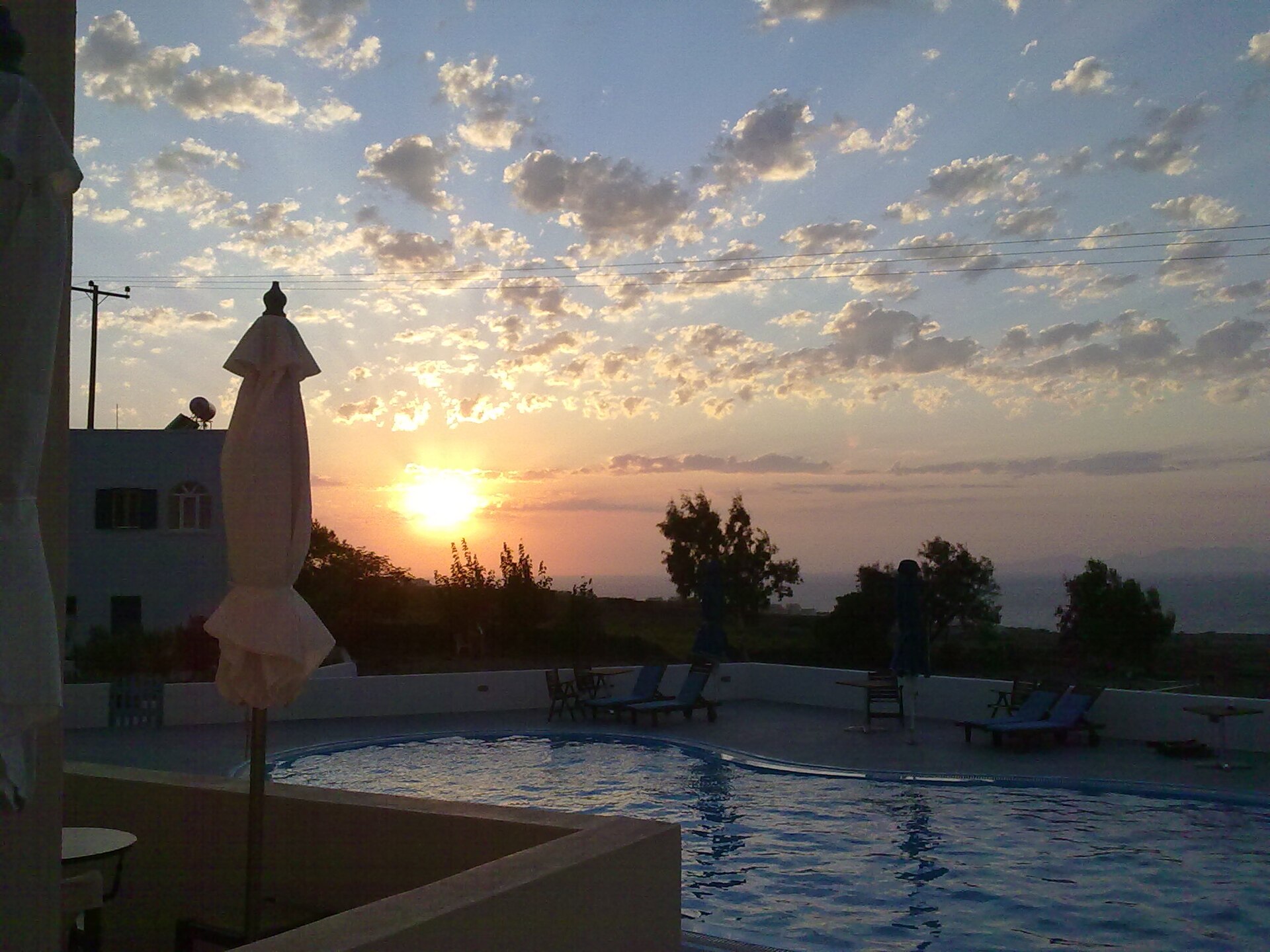
- Reach the chapel of Agia Kyriaki for a sunset in complete solitude.
When to go and how to experience the village
The best time to visit Foinikia is undoubtedly spring or early autumn. In the months of May and June, the landscape is still surprisingly green and wildflowers color the edges of the paths, while temperatures are ideal for hiking. September and October offer instead the charm of the grape harvest and a still-warm sea, with the advantage of fewer tourists. Foinikia should be experienced with slowness: it is a place that requires forgetting the clock and letting yourself be guided by curiosity. It is the ideal base for those who want to explore the north of the island while having a quiet refuge to return to in the evening, far from the constant buzz of more famous centers, rediscovering the pleasure of small things.
FAQ
È possibile raggiungere Oia a piedi da Foinikia?
Ci sono parcheggi disponibili nel villaggio?
Foinikia è adatta alle famiglie con bambini?
Si vede il tramonto sulla caldera da Foinikia?
Getting there
- Aeroporto Internazionale di Santorini (JTR) - 15 km
- Non sono presenti linee ferroviarie sull'isola.
- Dall'aeroporto o dal porto di Athinios, seguire le indicazioni per Oia. Foinikia si trova appena prima dell'ingresso principale di Oia.
- Noleggiare un'auto o un motorino è consigliato per esplorare le spiagge vicine, ma il villaggio è servito bene anche dai bus locali (KTEL) sulla linea Fira-Oia.
Perfect for
Ideale per gli amanti del vino che vogliono scoprire le antiche cantine e i vitigni autoctoni in un contesto autentico.
Perfetto per chi cerca un rifugio silenzioso e rurale, lontano dal caos pur essendo a pochi passi dalle attrazioni principali.
Un gioiello per chi desidera studiare le case-grotta tradizionali e l'uso dei colori pastello nelle Cicladi.
To see
What to see in Foinikia
Routes · Trovido Route